

How to Make Better Decisions Under Pressure
- LaTanya Edenburgs MA, M.Ed.
- Leadership & Decision-Making
Written by LaTanya Edenburgs, MA, M.Ed. | Published October 27, 2026
What's in this article?
- Why Pressure Can Change the Way You Decide
- The Difference Between a Fast Decision and a Clear Decision
- What Emotions Reveal About Your Decisions
- How to Make Better Decisions Under Pressure: Five Practical Strategies
- A Decision Framework for Leaders and Teams
- Using The MOVE Method™ to Move From Reaction to Intention
- Bring This Conversation to Your Organization
- A Better Way Forward
- Frequently Asked Questions
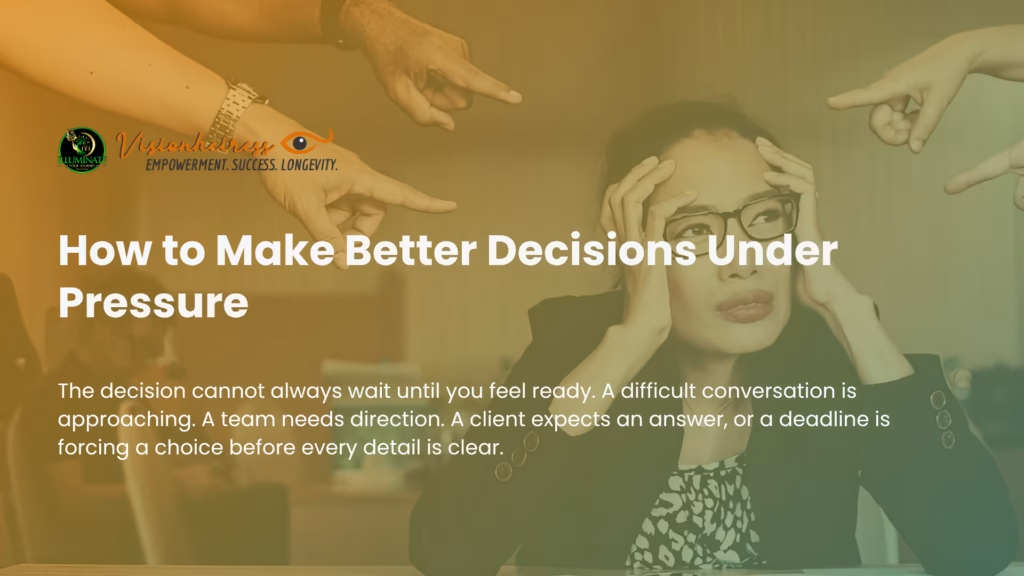
The decision cannot always wait until you feel ready.
A difficult conversation is approaching. A team needs direction. A client expects an answer, or a deadline is forcing a choice before every detail is clear. In moments like these, knowing how to make better decisions under pressure becomes more than a leadership skill. It becomes a question of how you respond when time, expectations, and emotions compete for your attention.
The instinct may be to move faster, take control, or trust your first reaction. Sometimes that is necessary. But speed alone does not guarantee sound judgment, and waiting for perfect certainty is rarely realistic.
The more useful skill is learning to recognize what is influencing your thinking, determine what the situation actually requires, and choose a response that reflects both immediate needs and longer-term consequences.
Because pressure does not just test the decision you make. It can shape the way you make it.
Why Pressure Can Change the Way You Decide
Pressure can make a decision feel more urgent than it actually is. It can also make familiar problems seem more complicated or cause people to overlook alternatives they might otherwise consider.
Research helps explain why this happens. A meta-analysis published in Neuroscience & Biobehavioral Reviews examined 51 studies involving 2,486 participants and found that acute stress impaired working memory and cognitive flexibility, although its effects varied across different executive functions and circumstances. These abilities help people hold information in mind, evaluate alternatives, and adjust their thinking when a situation changes.
Read the research on acute stress and executive functions.
For a leader, this matters because difficult decisions rarely involve a single piece of information. They often require weighing competing priorities, interpreting people’s responses, considering risks, and anticipating what could happen next.
When pressure affects the ability to consider multiple perspectives, the first available solution can begin to look like the only solution.
Imagine a manager whose team has fallen behind on a major project. Senior leadership wants an immediate explanation, employees are asking for direction, and the deadline is approaching.
The manager might respond by requiring daily progress reports and extending working hours. These actions create a sense of control, but they may not address the actual cause of the delay.
Perhaps the team has conflicting instructions. Perhaps an important approval is still pending. Perhaps the original timeline was unrealistic.
The manager’s next decision depends on what they can see beyond the immediate pressure.
Pressure makes a response feel necessary. Clarity helps determine which response is actually useful.
This distinction matters in business, education, healthcare administration, and any environment where decisions affect other people.
The goal is not to eliminate pressure. It is to develop a decision-making process that remains useful even when pressure cannot be removed.
The Difference Between a Fast Decision and a Clear Decision
Some decisions need to happen immediately. Others only feel immediate because someone is uncomfortable with uncertainty.
Learning to distinguish between the two can prevent unnecessary urgency from controlling the process.
A fast decision prioritizes speed. A clear decision prioritizes what the situation requires. The two can overlap, but they are not interchangeable.
Consider two situations.
In the first, a leader discovers an immediate safety concern. The appropriate response may be to act at once, protect the people involved, and follow the relevant procedures.
In the second, a leader receives a proposal to reorganize an entire department. There may be pressure to approve the plan quickly, but the consequences could affect budgets, responsibilities, morale, and long-term performance.
Treating both decisions with the same level of urgency would be a mistake.
Match the decision process to the consequences
Before deciding, consider three questions:
- How much time is genuinely available? Identify the real deadline rather than assuming everything must be resolved immediately.
- What happens if the decision is wrong? Consider the potential impact on people, resources, relationships, and future options.
- Can the decision be adjusted later? A reversible choice may require less deliberation than a decision that is difficult or costly to undo.
These questions help leaders decide how much analysis, consultation, and review a situation deserves.
They also create a healthier relationship with uncertainty. Instead of treating uncertainty as a reason to freeze or rush, leaders can use it to determine what information is still needed.
Recognize when urgency is emotional
Sometimes, the pressure comes less from the situation itself and more from the discomfort surrounding it.
A leader may feel compelled to respond immediately because they do not want to appear indecisive. A manager may agree to an unrealistic request because saying no feels uncomfortable. An executive may approve a familiar strategy because exploring alternatives introduces more uncertainty.
In each case, the desire to relieve discomfort can influence the decision.
Ask yourself: If I did not feel pressured to prove myself, avoid conflict, or satisfy everyone immediately, would I make the same choice?
The answer may not change your decision. But it can help you understand why that decision feels necessary.
And that brings us to another important part of decision-making: the role of emotions.
What Emotions Reveal About Your Decisions
Leadership decisions are often described as rational choices between competing options. In practice, emotions are part of how people interpret situations, recognize risks, and respond to other people.
Fear may draw attention to potential consequences. Frustration may signal that an expectation has repeatedly gone unmet. Disappointment may reveal a gap between what was expected and what actually happened.
The problem is not having emotions. The problem is treating the first interpretation an emotion produces as the complete explanation.
Imagine an employee questioning a decision during a team meeting. A leader who feels embarrassed might interpret the question as an attempt to undermine their authority. That interpretation could lead to a defensive response or a decision to exclude the employee from future discussions.
But the employee may have identified a genuine operational concern.
The leader’s emotional reaction is real. The assumption about the employee’s intention, however, still needs to be examined.
Emotional awareness creates a pause between what you experience and what you choose to do with it.
That pause can help leaders separate observable facts from assumptions, recognize when personal expectations are influencing their judgment, and remain open to information that challenges their initial view.
It also matters how leaders respond to their own mistakes. If admitting uncertainty feels like a threat to their credibility, they may defend an ineffective decision long after new information suggests a different approach.
Clearer decision-making requires the willingness to reassess.
This is not about becoming detached or suppressing emotion. It is about recognizing that emotions can inform a decision without having to dictate its outcome.
For leaders, the next question is practical: How can this awareness become a consistent habit rather than something remembered only after a difficult situation has passed?
How to Make Better Decisions Under Pressure: Five Practical Strategies
Improving decision-making under pressure does not require an elaborate process for every challenge. It requires a few reliable habits that help you assess the situation, use your available time wisely, and choose a response deliberately.
1. Pause long enough to assess the situation
A pause does not have to be long to be useful. In many situations, taking a few deliberate breaths or asking one clarifying question can help interrupt an automatic response.
Before replying to a difficult message or making a consequential commitment, ask yourself:
- What requires my attention right now?
- What can wait until I have more information?
- Am I responding to the situation or to the discomfort it creates?
When immediate action is necessary, use the pause to identify the safest or most appropriate first step. When time allows, use it to gather perspective before committing to a larger decision.
The objective is not to delay. It is to respond with greater awareness.
2. Separate what you know from what you assume
Under pressure, people can fill information gaps with explanations that feel convincing but have not been verified.
A missed deadline becomes evidence that someone is unreliable. A client complaint becomes proof that a relationship is failing. A disagreement becomes a sign that a colleague does not respect your leadership.
Before acting on an interpretation, identify the facts that support it and the information that remains unknown.
Ask, “What else could explain what happened?”
This question is especially useful when decisions involve other people’s intentions, performance, or behavior. It creates an opportunity to investigate the issue before assigning blame or choosing a response.
3. Identify the most important priority
Pressure often brings multiple demands into focus at once. Without a clear priority, leaders can spend their energy responding to whichever request is loudest or most recent.
Instead, identify the outcome that matters most in the situation.
If a project is behind schedule, is the immediate priority protecting quality, meeting a contractual deadline, resolving a dependency, or communicating a revised timeline? The answer will influence which options make sense.
Priorities should also reflect relevant responsibilities, organizational values, and the people affected by the decision.
A useful question is: “What must this decision protect, and what trade-offs are we willing to accept?”
This turns a vague sense of urgency into a more specific decision.
4. Consider alternatives before committing
The first solution that comes to mind may be workable. It may also reflect habit, familiarity, or the desire to resolve discomfort quickly.
When time permits, identify at least two realistic alternatives before making a consequential choice.
For each option, consider the likely benefits, possible risks, resources required, and people affected. Ask whether the option addresses the underlying problem or merely makes the immediate pressure less uncomfortable.
For example, when a team misses a target, a leader might consider increasing oversight, revising the timeline, or identifying and removing the obstacle preventing progress.
Each option has different implications. Comparing them helps reveal which response is most likely to address the actual issue.
Research on stress and decision-making also suggests that the effects of pressure depend on the task and circumstances. A review published in Psychological Bulletin examined 32 datasets involving 1,829 participants and found that stress influenced decisions under uncertainty, with the effects varying according to the decision context.
Explore the meta-analysis on stress and decisions under uncertainty.
The practical lesson is not that pressure always leads to poor decisions. It is that the decision process deserves attention, especially when uncertainty and consequences are significant.
5. Make the decision and define the next checkpoint
Once you have enough information to act, avoid extending the analysis simply because uncertainty remains.
A sound decision is not a guarantee of a perfect outcome. It is a choice made with appropriate consideration of the available evidence, constraints, and consequences.
Communicate what has been decided, why it was chosen, who is responsible for the next step, and when progress will be reviewed.
For decisions that may need adjustment, identify what new information or outcome would trigger a reassessment.
This helps leaders remain accountable without becoming rigid. It also gives teams a clearer understanding of what to do next instead of leaving them to interpret an announcement on their own.
A good decision process does not promise that nothing will g
A Decision Framework for Leaders and Teams
Individual habits matter, but decision-making is also shaped by the environment in which people work.
If employees are expected to respond immediately to every message, changing priority becomes the norm. If leaders punish people for raising concerns, important information may never reach the people making the decisions. If roles are unclear, even simple choices can become unnecessarily complicated.
Organizations can support better decisions by making expectations, responsibilities, and escalation procedures clearer.
One practical approach is to use a five-step framework during important or high-pressure situations.
Step 1: Define the decision.
State the specific question that needs an answer. Avoid mixing several separate problems into one decision.
Step 2: Establish the facts.
Identify what is known, what is uncertain, and which assumptions need to be checked.
Step 3: Clarify the priorities.
Determine the outcome the decision must support, the constraints that cannot be ignored, and the people who may be affected.
Step 4: Compare options and act.
Consider realistic alternatives, select the most appropriate response for the circumstances, and communicate the reasoning.
Step 5: Review the outcome.
Determine whether the decision achieved its purpose, what was learned, and whether anything needs to change.
This framework can be adapted for management meetings, staffing decisions, project challenges, school leadership, and organizational change.
It is particularly valuable when teams need to make decisions collaboratively. Instead of allowing the most senior or outspoken person to determine the direction by default, the process gives participants a shared way to evaluate the issue.
Leaders can strengthen the practice by asking team members:
- What are we assuming that we have not verified?
- What information or perspective might we be missing?
- What are the consequences if we wait, act, or choose another option?
- How will we know whether this decision is working?
These questions encourage thoughtful disagreement without turning every decision into a lengthy debate.
The framework should remain proportionate to the situation. A routine operational choice may need only a brief discussion, while a major organizational decision may require additional consultation and formal review.
The aim is not to make every decision slower. It is to make the decision process more appropriate to the stakes.


Using The MOVE Method™ to Move From Reaction to Intention
The MOVE Method™ offers a way to examine the internal experiences and pressures that can influence how people respond to challenging situations.
Its four components are Meet Yourself Where You Are, Own the Story, Validate the Pressure, and Elevate Forward. Applied to decision-making, the framework provides a practical sequence for recognizing your current state, examining your interpretation, acknowledging the pressure, and choosing a purposeful next step.
Meet Yourself Where You Are
Recognize what is happening within and around you before deciding how to respond.
Are you overwhelmed, frustrated, uncertain, or working with limited information? Acknowledging your current state helps you understand the conditions influencing your judgment without turning that awareness into self-criticism.
Own the Story
Examine the beliefs and assumptions shaping how you see the situation.
You may believe that changing your mind will make you look incapable, or that a disagreement means you have failed to earn your team’s respect. Recognizing these interpretations creates room to evaluate whether they reflect the facts or an expectation that deserves another look.
Validate the Pressure
Acknowledge the demands you are carrying instead of pretending they have no influence.
A difficult decision may involve financial responsibility, competing expectations, strained relationships, or concern about the people affected. Recognizing these pressures allows you to consider what support, information, or additional perspective might help.
Elevate Forward
Turn awareness into intentional action.
Choose the next step that best fits the situation. It may be making a decision, asking for clarification, having a difficult conversation, setting a boundary, or establishing a time to reassess.
The framework is not a substitute for technical expertise, organizational procedures, or evidence-based analysis. It complements them by helping leaders pay attention to the internal factors that can influence how they use those resources.
For those who want to explore this work further, IYRJ’s speaking and leadership development experiences bring mental clarity, intentional decision-making, and The MOVE Method™ into conversations with leaders, teams, schools, and organizations.
Bring This Conversation to Your Organization
Making better decisions under pressure is a skill that can influence how leaders communicate, how teams navigate uncertainty, and how organizations respond to change.
Through keynotes, workshops, and leadership development experiences, LaTanya Edenburgs helps audiences explore mental clarity, emotional intelligence, intentional decision-making, and practical ways to move from awareness toward action.
If this is a conversation your leaders, students, or team would benefit from having, explore IYRJ’s speaking experiences to learn how these ideas can be brought into your next event or leadership development program.
A Better Way Forward
You may not always have the time, information, or certainty you would prefer when a decision needs to be made. That is part of leadership.
What you can develop is a more intentional way of responding to those moments.
Learning how to make better decisions under pressure begins with recognizing that urgency, emotion, and uncertainty can influence your judgment without having to determine your next move. It means knowing when to act quickly, when to ask another question, and when a decision deserves a wider perspective.
The next time you feel pressured to provide an immediate answer, consider one question before you respond:
Am I choosing this because it is the most appropriate next step, or because I want the pressure to stop?
That distinction can open the door to a more considered response.
You do not need to eliminate pressure to lead well. You need a way to meet it with awareness, evaluate what matters, and move forward with intention.
Because the quality of a decision is shaped not only by the outcome, but also by the clarity and responsibility with which it was made.
Frequently Asked Questions
Start by identifying the decision that actually needs to be made. Separate facts from assumptions, clarify your priorities, consider realistic alternatives, and evaluate the consequences of each option. If time allows, pause before responding and seek another perspective when the stakes are significant.
Stress can affect cognitive functions involved in working memory and flexible thinking. This may make it harder to consider several alternatives or adjust your approach when circumstances change. The effects vary by situation, which is why recognizing pressure and using an appropriate decision process can be helpful.
Rather than trying to eliminate emotions, leaders can learn to recognize them and examine what they may be signaling. Identifying the difference between an observable fact and an emotional interpretation can help prevent an initial reaction from determining the final decision.
Intuition can reflect experience and the rapid recognition of familiar patterns. Impulsive decision-making involves acting without sufficient consideration of relevant information or consequences. Under pressure, leaders can examine whether their instinct is supported by experience and evidence or driven primarily by discomfort, fear, or urgency.
Leaders should consider the available time, the reliability of the information, the potential consequences, the people affected, and whether the decision can be changed later. They should also determine which organizational policies, professional standards, or legal requirements apply.
Teams can improve decision-making by clarifying roles, agreeing on priorities, sharing relevant information, and creating an environment where people can raise concerns. A simple process for defining the problem, comparing options, assigning responsibility, and reviewing results can help teams respond more effectively.
The MOVE Method™ consists of Meet Yourself Where You Are, Own the Story, Validate the Pressure, and Elevate Forward. These components encourage people to recognize their current state, examine the assumptions influencing their decisions, acknowledge pressure, and choose an intentional next step.
About the Author
LaTanya Edenburgs, MA, M.Ed.
Creator of The MOVE Method™ | Architect of Mental Clarity | Decision Strategist for Life and Leadership | Global Advisor for Leadership, Mental Clarity, and Human Sustainability | International Speaker | Best Selling International Author | Former Professional Athlete | Honorary Doctorate in Christian Leadership and Business, Embersong Christian University
LaTanya Edenburgs, MA, M.Ed., helps individuals, leaders, teams, students, and organizations navigate pressure, transition, and growth with greater clarity and intention. Her work brings together mental clarity, emotional intelligence, resilience, decision-making, and sustainable leadership to help people recognize what influences their choices and move forward with purpose.
As the creator of The MOVE Method™, LaTanya offers a framework for turning awareness into intentional action. Through speaking, workshops, coaching, and leadership development experiences, she creates opportunities for audiences to examine familiar patterns, strengthen their decision-making, and approach challenges with a more considered perspective.
Her work emphasizes a practical understanding of leadership: meaningful progress is not simply about doing more or moving faster. It is about making choices that support people, strengthen organizations, and create sustainable forward movement.
Have Any Question?
Do not hesitate to contact me. I am here to walk you through this journey.